
What is a call option?
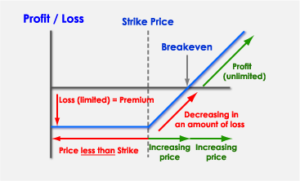
Call Options Trading Explained for Beginners
Call options trading is one of the most popular ways beginners start with options. Here’s a simple, beginner-friendly explanation (no complicated math or Greek letters yet).
What is a call option? (Think of it like this analogy)
Imagine you really like a house that’s currently worth $500,000.
You think in 3 months the price will jump to $600,000 because a new train station is coming nearby.
But you don’t have $500k right now to buy it.
Instead, the owner says:
“Pay me $5,000 today, and I’ll give you a signed paper saying: for the next 3 months you have the right (but not the obligation) to buy this house from me for $520,000 — no matter what the market price becomes.”
- If in 3 months the house is worth $600k → you use the paper, pay $520k, get the house instantly worth $600k → nice profit!
- If the house stays $500k or drops → you just throw the paper away and lose only the $5,000 you paid initially.
That $5,000 is called the premium.
The fixed price ($520k) is called the strike price.
The time limit (3 months) is the expiration date.
The paper itself is a call option.
In stock market language (very similar)
A call option is a contract that gives you (the buyer) the right — but not the obligation — to buy 100 shares of a stock
at a fixed price (strike price)
any time until a certain date (expiration).
You pay a price for this right → called the premium (quoted per share, but contracts are usually for 100 shares).
Most common beginner trade: Buying a call (Long call)
You’re bullish — you think the stock price will go up a lot.
Example — real numbers style:
Stock: Tesla (TSLA) currently trading at $420 per share.
You buy 1 call option contract:
- Strike price: $440
- Expiration: 6 weeks from now
- Premium: $8.50 per share
→ Total cost = $8.50 × 100 shares = $850 (plus small fees)
What can happen:
- Best case — TSLA rockets to $520 in 5 weeks
Your call is now worth much more (maybe $85 per share or more).
You can sell the option itself for ~$8,500 → profit ≈ $7,650 (huge % return on $850 risked) - Good but not moon — TSLA goes to $455
Option still has value (maybe worth $18–20). You sell for profit. - Nothing happens — TSLA stays $420–$439
Option expires worthless → you lose the full $850 premium. - Worst case — TSLA drops to $350
Option expires worthless → lose $850 (but you can’t lose more than the premium you paid — very important!)
Quick summary table — Buying a Call
| Your belief | Strategy | Max loss | Max profit | Breakeven price |
|---|---|---|---|---|
| Stock will go UP strongly | Buy call | Premium paid only ($850 in example) | Unlimited (theoretically) | Strike + premium ($440 + $8.50 = $448.50) |
Two golden rules for beginners
- Most people lose money buying options — especially short-term ones — because time works against you (theta decay) and the stock must move enough to cover the premium.
- Start very small (1 contract), paper trade first (many brokers offer free simulators), and never risk money you can’t afford to lose completely.
Once you understand buying calls, the next step is usually learning put options (betting the price goes down), then maybe selling options (collecting premium but with bigger risks).