
Tech’s March Madness: Creating the Ultimate Humanoid Robot
The NCAA championship game took place last night. And as a former college hoops player and lifelong basketball fanatic, I was fully locked in. March Madness is all about buzzer-beaters, Cinderella stories, and big-time plays under bright lights. Not to mention, it was a welcome distraction from the bloodbath taking place on Wall Street…
But do you know what makes the game really great?
The mistakes – missed shots and turnovers, blundered defensive rotations that leave a shooter wide open in the corner. The heartbreak, the chaos – it’s all part of the drama.
If the players were perfect, the game wouldn’t be half as fun. It would feel too predictable; robotic.
Now, speaking of robotic, I’m convinced we’re not far off from a world where AI-powered robots could play a full game of basketball. I’ve seen humanoid bots dance, make drinks, flip burgers, play rock-paper-scissors, and even shoot jumpers. Give it a few years, and they might be able to run a basic pick-and-roll.
But let me be clear: robots will never replace humans on the basketball court. The reason we love the game – why March Madness lives up to its name – is because of the unpredictability that is born from human imperfection.
That is unique to sports. Basketball might be fun because of mistakes… But mistakes in a warehouse? On a freeway? At a shipping dock?
In those domains, mistakes are painful and expensive. They slow down supply chains. They break things. Often, they cost lives.
And we believe that’s exactly why those areas are about to be completely overtaken by robots.
The Future Is Robotic
We’re already seeing it. In some places, it’s not the future; it’s happening right now.
Let’s start with a company called Symbotic (SYM).
This firm isn’t making cute dancing bots to generate hype. It’s built a full-blown end-to-end warehouse automation system.
Symbotic uses fleets of smart, self-guided robots to sort, store, and move products faster, cheaper, and with near-perfect accuracy.
In fact, Walmart (WMT) was so impressed with this tech that it inked a deal with Symbotic to automate every one of its regional distribution centers in the U.S.
That’s not hype. That’s the world’s biggest retailer betting on robot supremacy in one of the most operationally complex businesses on the planet.
Why? Because robots don’t call in sick, get tired, or make costly mistakes.
And this isn’t just about fulfillment centers. Robotic tech is hitting Main Street as well.
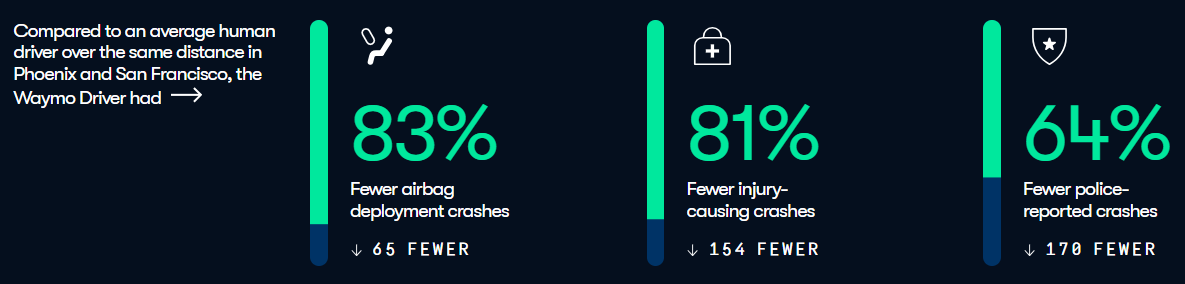
Alphabet (GOOGL) subsidiary Waymo has developed a full self-driving system that’s already being used in real-world robotaxi services. You could call one up in Phoenix, San Francisco, L.A., or Austin right now and get picked up by a car with no driver at all.
And every single day, those systems are quietly getting smarter, safer, and more capable.
According to Waymo’s Safety Impact data, as of December 2024, it has driven 50 million rider-only miles without a human driver. And compared to its human benchmark:
Meanwhile, Tesla (TSLA) is busy developing Optimus, its humanoid robot that already works in its factories. Meta (META) just launched a new business unit focused on humanoid bots. Apple (AAPL) is reportedly developing a suite of robotic systems for smart home integration. Alphabet has invested in humanoid startups like Apptronik, and Nvidia (NVDA) is creating AI models tailor-made for embodied intelligence: robots that can perceive and interact with the real world.
AI 2.0: Humanoid Robots
Right now, everyone’s still distracted by AI chatbots. And don’t get me wrong; ChatGPT, Grok, and their peers are impressive and transformative in many ways.
But they’re also digital. They exist in the cloud, in a browser and on your phone.
Their real-world impact is still mostly confined to assisting with research, refining communications, and automating customer support. In our view, that’s merely AI 1.0.
The next big wave of AI is based in the physical, with the merging of intelligence and motion.
It’s AI that can respond to real-world environments; embodied intelligence that can see, hear, walk, talk, lift, carry, organize, fix, learn…
That’s where we believe the next trillion-dollar investment opportunities will be found.
After all, there’s a reason why every tech titan is suddenly obsessed with humanoids. If you want to have a robot do useful work – whether in a house, a factory, or a store – it has to navigate an environment built for humans.
That’s why the humanoid form is so compelling.
A robot that functions like us can do things like operate tools and machinery, climb and descend stairs, open doors, and navigate clutter. It will be adaptable to a wide range of tasks and industries, making it a general-purpose labor platform, much like a computer is a general-purpose computation platform.
That’s the bet Tesla is making with Optimus. That’s why Meta, Apple, and Microsoft are quietly building foundational tools and systems for humanoids and why OpenAI is reportedly exploring robotics hardware.
Once these robots hit critical usability, every sector of the economy will want one… or thousands.
The Final Word
So, yes, nobody wants to watch a robot take the final in an NCAA title game. Let’s leave the joys of living to the alive.
But everyone could use one to clean their house, unload groceries, assemble furniture, care for their pets – even patrol properties or assist with an aging parent.
The list goes on. And what’s wild to us is that these robots are almost ready. They’re already working in closed environments. The only thing left? Mass deployment.
That’s why this moment matters. We believe that over the next few years, we’re going to see the physical AI equivalent of a Cambrian explosion.
And the companies at the forefront of this revolution could become the biggest winners of the next decade.
So, where should investors be looking?
You want to find the companies that are:
- Building hardware platforms like Optimus and Apptronik
- Creating robot operating systems (Meta, Nvidia, OpenAI)
- Supplying AI chips, sensors, and actuators
- Developing integration services for homes, factories, and retail environments
In other words, the era of AI 1.0 gains is coming to an end. It’s time to be on the lookout for AI 2.0’s future winners – AI + robotics stocks. That’s where the real compounding begins.
The Robot Revolution won’t be loud. It’ll creep in through efficiency and cost reduction – use cases that make perfect business sense.
And then, suddenly, it’ll be everywhere.
Last night, we watched imperfect humans battle it out on the basketball court – and loved every minute of it.
But now that the Florida Gators have clinched the title win, it’s back to work for the rest of the world. And increasingly, that work will be done not by people but by robots.
The AI boom started with code. But its future moves.
And it’s about to move markets, too.
Learn more about some of our favorite robot stocks right now.
On the date of publication, Luke Lango did not have (either directly or indirectly) any positions in the securities mentioned in this article.
P.S. You can stay up to speed with Luke’s latest market analysis by reading our Daily Notes! Check out the latest issue on your Innovation Investor or Early Stage Investor subscriber site.


