Why U.S. Government Spending and Money Growth Can Benefit Visa and Mastercard
Visa and Mastercard are often viewed simply as credit-card companies. In reality, they operate two of the largest payment networks in the world—and that makes them unusually well positioned to benefit when more dollars flow through the economy.
With U.S. government spending remaining historically high, federal deficits elevated and the broader money supply expanding again, investors are paying closer attention to businesses that can benefit from the increasing nominal value of transactions.
Visa and Mastercard sit directly in the middle of that system.
The First Important Point: The Government Doesn’t Simply “Print Money”
The phrase “money printing” is commonly used in financial markets, but the actual process is more complicated.
The U.S. Treasury funds government expenditure using tax revenue and borrowing through the issuance of Treasury securities. Separately, the Federal Reserve controls monetary policy and can increase or decrease liquidity within the financial system.
Nevertheless, sustained government deficits can inject significant amounts of spending into the economy.
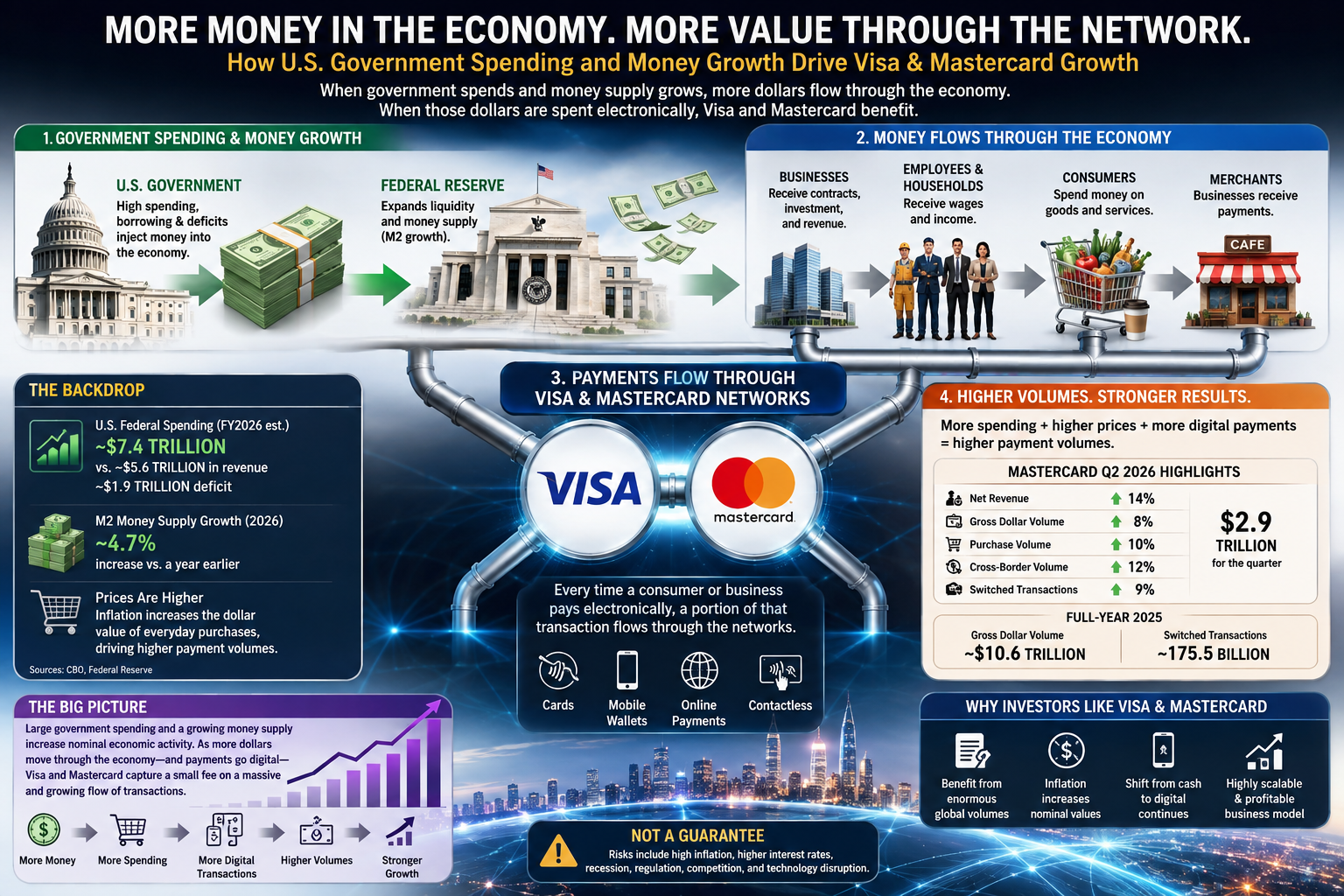
The Congressional Budget Office projects approximately $7.4 trillion in U.S. federal spending during fiscal 2026, against approximately $5.6 trillion in revenue, producing a projected deficit of around $1.9 trillion. (Congressional Budget Office)
More recent CBO estimates show the federal deficit had already reached approximately $1.8 trillion during the first ten months of fiscal 2026, with government outlays up around 5% compared with the same period a year earlier. (Congressional Budget Office)
At the same time, money circulating through the financial system has been expanding.
The Federal Reserve reported that M2 money supply during the first five months of 2026 averaged approximately 4.7% above its level a year earlier. (Federal Reserve)
That combination matters for companies such as Visa and Mastercard.
More Dollars Flowing Through the Economy
Imagine the U.S. economy as a giant network of pipes.
Government expenditure, wages, business investment, bank lending and credit provide the water.
Visa and Mastercard own some of the largest pipes through which that money travels.
When consumers spend money at supermarkets, restaurants, airlines, hotels and online retailers, a significant proportion of those transactions travels through Visa or Mastercard’s networks.
The companies generally do not need consumers to become dramatically wealthier.
They primarily need more transactions and greater dollar volumes moving through their networks.
That creates an important relationship:
Higher nominal spending → greater payment volume → potentially higher Visa and Mastercard revenue.
Inflation Can Actually Increase Payment Volumes
There is another factor investors sometimes overlook.
Inflation increases the dollar value of everyday purchases.
Consider a household spending:
- $150 at a supermarket instead of $120
- $90 filling a vehicle instead of $70
- $250 for a hotel instead of $200
If those purchases are made electronically, Visa or Mastercard may process a higher dollar value even though the customer has purchased roughly the same amount of goods.
Mastercard’s filings explain that part of its payment-network revenue is generated from fees linked to the gross dollar volume of activity across its network, alongside transaction-processing charges. (SEC)
This gives payment networks a characteristic that investors often find attractive during periods of moderate inflation:
They participate in nominal economic growth.
Higher prices can therefore translate into higher payment volumes, although severe inflation that damages consumer demand would eventually become negative.
Government Spending Eventually Becomes Private-Sector Spending
Government expenditure does not simply disappear after Washington spends it.
Money moves through multiple layers of the economy.
For example:
Federal Government
↓
Infrastructure contracts, defence spending, Social Security, Medicare, government salaries and other expenditure
↓
Businesses and households receive money
↓
Employees receive wages and companies receive revenue
↓
Consumers spend money
↓
Retailers, restaurants, travel companies and online businesses receive payments
↓
Visa and Mastercard process a portion of those transactions
This is one reason extremely large fiscal expenditure can indirectly benefit payment networks.
The government does not need to send money directly to Visa.
It simply needs to contribute to overall economic activity.
The Numbers Are Already Significant
Mastercard’s latest reported figures illustrate just how powerful payment-volume growth can be.
For the second quarter of 2026, Mastercard reported:
- Net revenue up 14%
- Gross dollar volume up 8%
- Purchase volume up 10%
- Cross-border volume up 12%
- Switched transactions up 9%
Gross dollar volume reached approximately $2.9 trillion for the quarter. (SEC)
For full-year 2025, Mastercard processed approximately $10.6 trillion in gross dollar volume, while switched transactions reached approximately 175.5 billion. (SEC)
This demonstrates why even relatively small changes in consumer spending and transaction values can become extremely significant when applied across trillions of dollars.
Why Investors Like Visa and Mastercard in This Environment
There are several reasons investors may view these companies favourably when government spending, money supply and nominal GDP are expanding.
1. They Take Part in Enormous Transaction Volumes
Visa and Mastercard operate global networks rather than relying on one product or one retail sector.
They benefit from activity across restaurants, supermarkets, travel, e-commerce, business payments and many other areas.
2. Inflation Can Increase Nominal Transaction Values
A transaction increasing from $100 to $110 creates higher dollar payment volume even if the underlying purchase has barely changed.
Across trillions of dollars of annual spending, that difference becomes substantial.
3. The Shift Away From Cash Continues
Government spending alone does not explain the growth of Visa and Mastercard.
One of the most important structural forces supporting both businesses is the continuing global shift from cash toward:
cards → mobile wallets → online payments → contactless payments → digital commerce.
Even if total economic spending remained unchanged, Visa and Mastercard could potentially continue capturing a greater percentage of it as cash usage declines.
4. Their Business Models Are Highly Scalable
Visa and Mastercard generally do not operate like traditional lenders issuing most of the credit themselves.
They provide the infrastructure connecting consumers, banks and merchants.
Once the network exists, processing additional transactions can be highly profitable.
That scalability helps explain why investors frequently value payment networks more like technology infrastructure companies than traditional banks.
There Is Also an Asset-Inflation Effect
Government deficits and monetary expansion can have another indirect consequence.
When investors believe that the supply of dollars will continue increasing over the long term, they may become reluctant to hold large amounts of cash.
Capital can instead move toward:
- equities
- property
- gold
- Bitcoin
- infrastructure
- profitable companies with pricing power
Large payment companies can benefit from this behaviour because they represent ownership in businesses whose revenues can grow alongside nominal economic activity.
If the number of dollars circulating through an economy increases substantially over many years, a company collecting a small fee from billions of those transactions may become progressively more valuable.
But Money Printing Does Not Automatically Mean Visa Goes Up
This distinction is important.
It would be incorrect to claim:
“The government prints money, therefore Visa and Mastercard shares must rise.”
Several things could break the relationship.
If excessive government borrowing produces persistently high inflation, the Federal Reserve may maintain higher interest rates.
Higher rates can reduce economic activity and pressure stock-market valuations.
Consumers could also reduce discretionary spending if the cost of living rises faster than wages.
Regulation of payment fees, increased competition, recession, credit stress and technological disruption are additional risks.
The relationship therefore looks more like:
Government spending and liquidity
↓
Higher nominal economic activity
↓
Higher consumer and business spending
↓
More electronic transactions
↓
Higher Visa/Mastercard payment volumes
↓
Potential revenue and earnings growth
↓
Potentially stronger share prices
—not a guaranteed straight line.
The Bigger Picture
The strongest argument for Visa and Mastercard is therefore not simply “money printing.”
It is that both companies occupy an extremely valuable position inside a financial system where the amount of money changing hands has historically increased over time.
Government expenditure is large.
U.S. federal debt continues to expand.
The broad money supply is growing again.
Prices are substantially higher than they were a decade ago.
Consumers are increasingly abandoning cash.
And trillions of dollars are moving through electronic payment networks every year.
Visa and Mastercard essentially operate financial toll roads across this expanding digital economy.
Every additional dollar of nominal spending does not become revenue for them—but when trillions of additional dollars circulate through the global economy, collecting fractions of those flows can produce extraordinarily powerful economics.
That is one reason payment-network companies can perform strongly during periods of expanding nominal GDP, rising electronic-payment adoption and resilient consumer expenditure.
Conclusion
The relationship between U.S. fiscal spending, monetary expansion and companies such as Visa and Mastercard is indirect—but important.
When the government runs large deficits and substantial amounts of money continue circulating through the economy, household income, business revenue and nominal spending can increase.
When those dollars are spent electronically, Visa and Mastercard are positioned to collect fees from portions of that activity.
Combined with inflation, growth in digital payments, international travel and the continuing decline of cash, this helps explain why payment networks can remain extremely profitable even in an economy carrying enormous government debt.
For investors, perhaps the most important idea is simple:
Visa and Mastercard don’t need to predict exactly where every dollar will be spent. They benefit from owning the infrastructure through which an enormous amount of those dollars must travel.
Educational Disclaimer
This article is provided for educational and informational purposes only and does not constitute financial, investment or trading advice. Financial markets involve risk, and past performance does not guarantee future results. Investors should conduct their own research and consider their financial circumstances and risk tolerance before making investment decisions.