
Blue-Chip Bonanzas: 3 Industry Leaders Trading at Unbelievable Discounts
When it comes to targeting discounted ideas in the equities sector, undervalued blue-chip stocks offer some of the most compelling prospects. First and foremost, blue chips earn the status through decades of business and earnings expansion. In other words, they’re predictable stalwarts that can be depended on in good times and bad.
As an investor, understanding this point gives you a clear advantage. Usually, when you hear about a “cheap” security in the financial information sector, it’s tied to an exciting enterprise. Maybe it’s a small-capitalization firm or a pre-revenue entity aligned to a burgeoning industry. The point is, it appears cheap based on its potential. However, potential is never guaranteed to materialize.
On the other hand, blue chips don’t really deal with potential; they deal with proven realities. If they also happen to be trading at metrics below their intrinsic valuations, those are discounts you can trust. Eventually, the stalwart should rise above the muck.
With that in mind, below are undervalued blue-chip stocks to put on your radar.
AbbVie (ABBV)

Source: Valeriya Zankovych / Shutterstock.com
Pharmaceutical giant AbbVie (NYSE:ABBV) primarily offers an intriguing case for undervalued blue-chip stocks thanks to its Allergan buyout. With the acquisition of one its rivals, the company brought the anti-wrinkle treatment Botox under its belt. That’s likely going to be one of the most relevant treatments because of shifting social mores.
Basically, because of social media, people are more focused on their superficial qualities. As young people get older – because, you know, life and all – they will likely have a more difficult time letting go. Cynically, that’s where Botox might come into play. AbbVie is a long-term play and so any valuation argument in my opinion must incorporate Botox’s potential.
On paper, ABBV trades at a price/earnings-to-growth (PEG) ratio of 0.99X. In contrast, the sector median for the drug manufacturing space is 1.66X. That technically makes ABBV one of the undervalued blue-chip stocks. However, as I stated earlier, the fundamentals are what makes AbbVie compelling.
Also, keep in mind that while you’re waiting for the narrative to pan out, AbbVie pays a forward annual dividend yield of 3.64%.
McDonald’s (MCD)
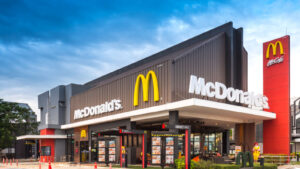
Source: Tama2u / Shutterstock
One of the world’s most recognizable brands, McDonald’s (NYSE:MCD) is as much a fast-food giant as it is an icon of American business. The opening of its stores in international markets has been celebrated in history books as informal acts of diplomacy. So, it’s difficult for such a massive enterprise to be considered one of the undervalued blue-chip stocks. However, a compelling case can be made here.
Although the company suffered a slight miss in earnings for the first quarter of 2024, overall, the financial performance has been impressive. In the past four quarters, its average earnings per share reached around $2.96. This translated to an earnings surprise of nearly 6%. For fiscal 2024, experts anticipate EPS to hit $12.19, an increase of 9.3% over the prior year.
However, given the robust performance of MCD, it’s possible that the company can eventually hit the high side of the earnings spectrum. That would mean EPS of $12.70 in fiscal 2024, translating to a forward multiple of 20X. Moreover, the blue-sky target for fiscal 2025 stands at $14.20. Combined with McDonald’s new business initiatives, it’s not an unreasonable projection.
Exxon Mobil (XOM)
Source: Jonathan Weiss / Shutterstock.com
At first glance, Exxon Mobil (NYSE:XOM) might not seem like an enticing proposition for undervalued blue-chip stocks. As an integrated oil and gas giant, Exxon covers multiple areas of the hydrocarbon value chain. That’s a positive, obviously. However, the ideological and political machinery have emphasized the development of renewable infrastructure. Taken to its logical conclusion, XOM seems irrelevant.
Fundamentally, though, the world still runs on oil. And that narrative might not change substantively until all underlying infrastructural networks incorporate new energy solutions. Until then, innovations like electric vehicles may be more of a luxury item for wealthier households. So, with big oil likely to enjoy sustained relevance, that right there changes the valuation discussion.
Now, on paper, nothing about Exxon seems like a particularly great deal. For example, fiscal 2024 revenue calls for 1.5% growth to $349.8 billion. That’s not remarkable. However, the most optimistic target calls for sales of $435.21 billion, up 26.3% from the prior year.
Should that print materialize, XOM would be trading at 1.16X projected revenue. That might be a more realistic valuation given the underappreciated demand profile for hydrocarbons.
On the date of publication, Josh Enomoto did not have (either directly or indirectly) any positions in the securities mentioned in this article. The opinions expressed in this article are those of the writer, subject to the InvestorPlace.com Publishing Guidelines.


